We can help to meet regulationsThe District provides guidance to landowners related to agricultural environmental regulations. Farms are regulated – determining how and how much can be confusing. The District has a delegation agreement with the State Conservation Commission and the PA Department of Environmental Protection for the implementation of the Commonwealth's Nutrient Management Program (Act 38) and the Manure Management Program (Chapter 91).
Act 38, requires high-density animal operations to develop and implement approved Nutrient Management Plans. Every farm in Pennsylvania that has animals and/or land applies manure or agricultural process wastewater (generated on the farm or received from an importer), regardless of size, is required to have and implement a written Manure Management Plan. This includes manure and agricultural process wastewater application by various types of equipment and/or direct application of manure by animals on pastures and in Animal Concentration Areas (ACAs). In other words, farms that do not mechanically apply manure but which do have pastures or ACAs still need a manure management plan. This applies for any size of farm from 1 animal to thousands of animals. A person who has 1 horse or 1 goat in the back yard is under these regulations, although their plan will look different than one for a farm with 2,000 cows. An Act 38 Nutrient Management Plan (as required by CAO and CAFO operations) must be written by a PA Certified Nutrient Management Specialist. A producer that is following an Act 38 Plan that is reviewed and approved the County Conservation Board has some limited liability protection. PA Chapter 91, Manure Management regulations address pollution control and prevention at agricultural operations and requires a Manure Management Plan. All farms generating manure are required to have a management plan. The Manure Management Plan can be written by the farmer or anyone using the State “Land Application of Manure A Supplement to Manure Management for Environmental Protection”. Farm maps are one of the requirements for the Plan. Maps can be hand-drawn or computer-generated. The PA ONESTOP website is a site that anyone can use to make a farm map with all of the required information. Contact the Conservation District if you would like more information regarding the preparation of a Manure Management Plan. PA Chapter 102, Farmers are required to have Agricultural Erosion & Sedimentation plans for their operations if they have over 5,000 square feet of earth disturbances from agricultural plowing or tilling activities (this does include no-till cropping methods and animal heavy use areas). An Ag E&S plan can be written by a certified planner, the Conservation District, a landowner or anybody with knowledge of the farming operation. The PAOneStop website includes an Ag E&S Plan module. This module can be used to calculate the soil loss for the Ag E&S Plan. It can also be used to create the required maps. PA DEP has also developed a “Soil Erosion and Sediment Control Manual for Agricultural Operations” manual to be used in writing Ag E&S Plans. This Manual can be found at Ag Manual Link. A Conservation Plan that has been written by USDA-NRCS may meet most of the requirements of the AG E&S Plan. NRCS plans may or may not address the Near Stream Areas or AHUA criteria. A Landowner should request NRCS to write a Conservation Plan that meets the AG E&S (or Chapter 102) requirements. Contact the NRCS office to make this request. For more information on these regulations, contact the District at 814-887-4001 |
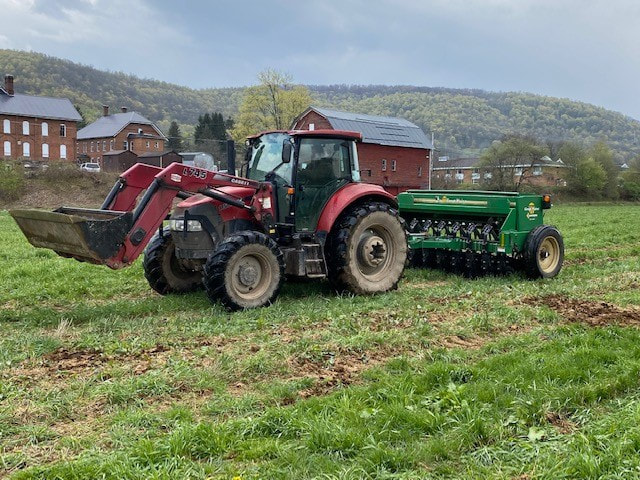
District's No-Till Drill
|
|
Financial & Technical Assistance
The Agriculture Conservation Assistance Program (ACAP) was created through the Clean Streams Fund established by the FY2022-23 General Funds Sate Budget. The purpose of the $154 million program is to assist farmers and landowners in the design and installation of agricultural BMP’s that will reduce or prevent nutrient and sediment losses from their farms and improve water quality and soil health across the Commonwealth. Each county conservation district will receive three equally-divided annual allocations. McKean County’s apportionment is approximately $860,321.00 or $286,773,000 for each allocation. All funds must be committed by December 31, 2024 and spent by December, 31, 2026. Applying for ACAP Grants Applications can be submitted to the District, once the program participant has held a pre-application site visit with the District. This allows the District to work jointly with the program participant to ensure the application is in the best interest of the program and the program participant. It also allows the district to provide input on the potential project at an early stage before the program participant has invested a large amount of time and resources developing the application. Contact Adam Causer, Watershed Specialist at 814-887-4003 or [email protected] to schedule your pre-application site visit or for more information. |